04 / Technology
Brain-Computer Interfaces
Bridging the gap between biological thought and digital execution. A BCI acquires brain signals, analyzes them, and translates them into commands that are relayed to an output device.
Standard BCI Architecture
1. Signal Acquisition
Electrodes capture neural activity (EEG, ECoG, or Intracortical).
2. Decoding & Feature Extraction
Algorithms process the signal, filtering noise and identifying patterns.
3. Output Translation
Pattern is converted into a command (e.g., cursor movement, prosthetic control).
What signals do BCIs measure?
Different BCIs work with different biological signals. Some systems measure large-scale rhythms from many neurons at once, while others try to capture much more local activity from the brain surface or within cortex itself. The choice of signal affects accuracy, safety, setup complexity, and the kinds of tasks the interface can support.
EEG
Electroencephalography records summed electrical activity from the scalp. It is widely used because it is non-invasive, portable, and relatively affordable, but the signals are spatially blurred by the skull.
ECoG
Electrocorticography records from electrodes placed on the brain surface. It typically offers better spatial and temporal precision than EEG, but requires surgery.
Intracortical Recording
Microelectrode arrays can sample activity from very small groups of neurons or even single units. This can support high-resolution control, but it is the most invasive and technically demanding approach.
Learning to use a BCI
A BCI is not usually something a person controls perfectly on first contact. Users often need training to discover mental strategies that produce reliable signal patterns, and the system needs calibration to learn how those patterns map onto intended actions.
In practice, this means BCI control is shared work between a human learner and an adaptive machine. Visual, auditory, or tactile feedback helps the user refine their strategy, while the decoder updates its model of what the person is trying to do.
Educational takeaway
BCIs are best understood as interactive systems, not mind-reading devices. They work by measuring limited signals, estimating intent, and improving through repeated feedback and training.
What makes BCIs difficult
Brain signals are informative, but they are also noisy, variable, and context dependent. A useful BCI must capture a signal that is both measurable and meaningfully related to user intent. It then has to translate that signal quickly enough to feel controllable while adapting to fatigue, electrode drift, and day-to-day biological variation.
This is why BCI performance depends not just on hardware, but on user training, feedback design, signal processing, calibration, and the task being attempted.
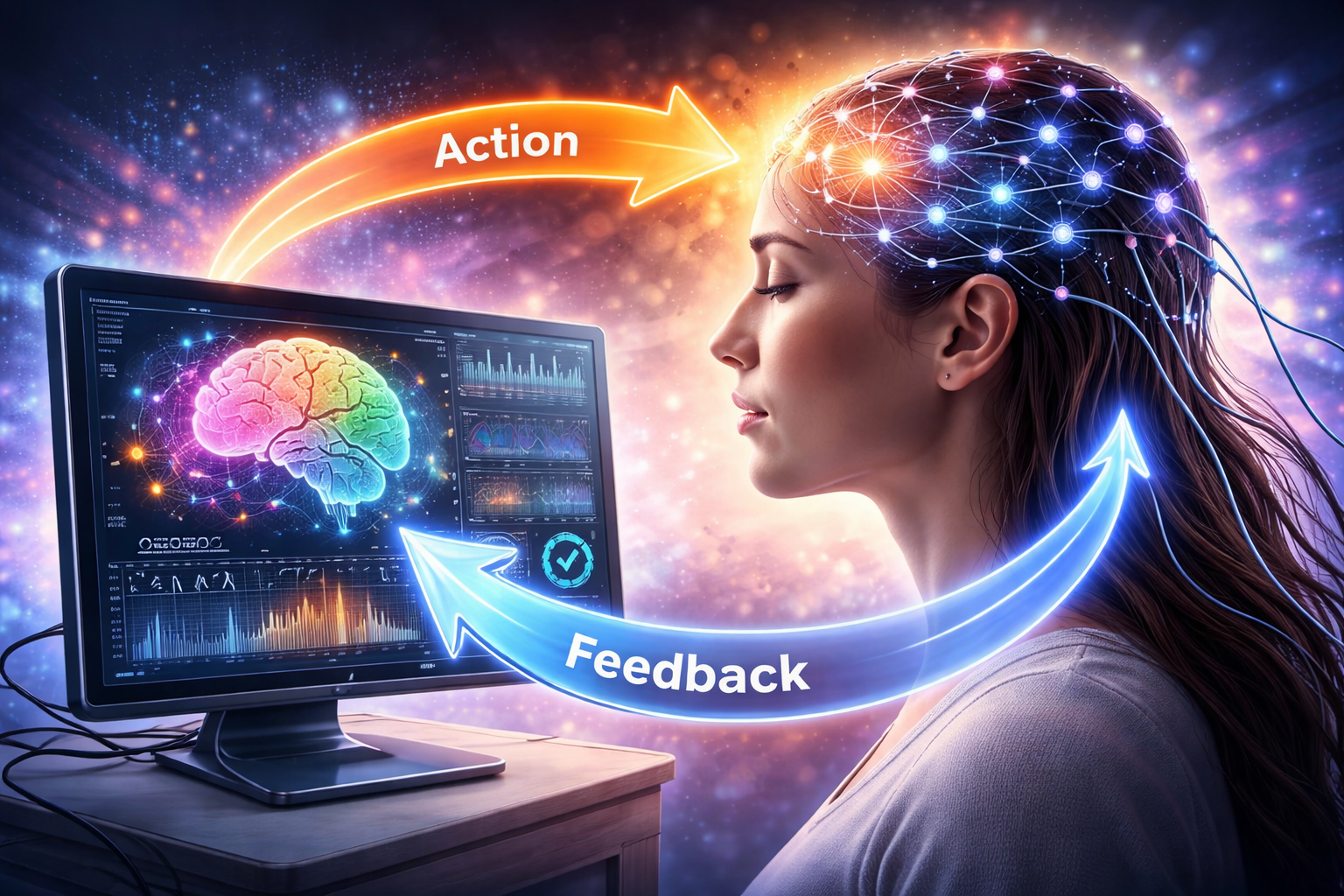
Closed-loop control
The most effective BCIs behave like closed-loop systems. Users act, receive feedback, and adjust their strategy, while the decoding system also adapts to the user. This shared adaptation is central to practical control.
Invasive vs. Non-Invasive Methods
Non-Invasive (EEG)
Electrodes are placed on the scalp. This approach is safer, more affordable, and easier to deploy than implanted systems. However, the skull and surrounding tissue blur the signal, lowering spatial resolution and making the recording vulnerable to motion, muscle, and environmental noise.
Non-invasive BCIs are often a good fit for communication interfaces, attention monitoring, and certain rehabilitation paradigms, especially when ease of access matters more than single-neuron precision.
Invasive (Implanted)
Microelectrode arrays are surgically implanted directly into or onto the cortex. This can provide much richer, more precise signals, but introduces surgical risk, tissue response, device maintenance challenges, and long-term durability concerns as signals degrade or biological conditions change.
Applications & Ethics
Clinical Applications
Current BCIs are most compelling when they restore lost function. Clinical targets include communication systems for people with ALS or locked-in syndrome, neuroprosthetic control for paralysis or limb loss, and rehabilitation platforms that pair brain signals with robotic or electrical assistance during recovery.
Technical Challenges
Significant hurdles remain: preserving signal-to-noise ratio, reducing latency, handling user fatigue, building robust decoders that generalize beyond ideal lab conditions, and for implants, limiting the foreign body response that can degrade performance over time.
Ethical Considerations
As BCI technology advances, critical questions emerge regarding neurorights. These include cognitive privacy (who owns neural data?), agency and autonomy (who is responsible if an algorithm misinterprets intent?), and equitable access to cognitive enhancement versus medical necessity.
Clinical reality vs. public imagination
Popular discussions often imagine seamless mind-controlled consumer devices, but most meaningful BCI work is still oriented around medical need. The strongest near-term cases involve communication restoration, movement assistance, and rehabilitation rather than entertainment or enhancement.
This distinction matters because it keeps expectations aligned with current evidence and helps frame ethical debates around benefit, risk, and access.
A useful mental model
You can think of a BCI as a translator between neural activity and a device. The translator is never perfect, because human intent is not a single clean signal. Instead, BCIs estimate useful patterns and convert them into outputs that are good enough to support communication or control.
Better hardware improves what can be measured, but better system design determines whether the user can actually learn to use it effectively.
Resources Used
These references support the educational summaries on this page and are included so readers can continue into primary or institutionally reviewed material.
Brain-machine interfaces: past, present and future
Used for the standard BCI pipeline, system bottlenecks, and historical context.
Clinical Applications of Brain-Computer Interfaces: Current State and Future Prospects
Supports current clinical use cases and near-term assistive applications.
Review on brain-computer interface technologies in healthcare
Used for newer healthcare-oriented applications, technical limits, and translational challenges.
Electrical and Magnetic Neuromodulation Technologies and Brain-Computer Interfaces: Ethical Considerations for Enhancement of Brain Function in Healthy People
Supports the ethics section on privacy, autonomy, safety, and enhancement concerns.